

What about STEAM
The early history of farming with steam power
The transition from muscle power to steam power in the late 19th and early 20th centuries revolutionized agriculture. Before the widespread adoption of the internal combustion engine, steam traction engines provided the first real alternative to the limitations of horses and oxen.
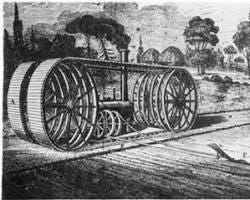
The most significant advantage of steam was its massive pulling power. A single steam traction engine could do the work of 20 to 30 horses. Steam power made large-scale farming possible.
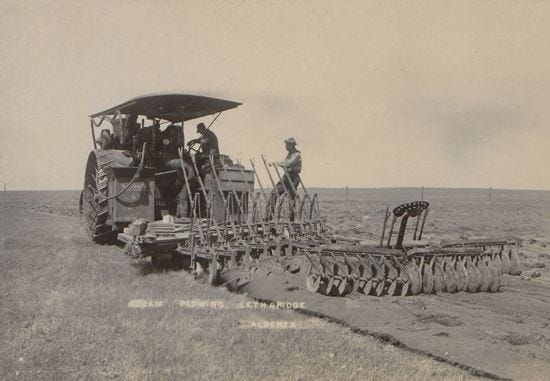
Plowing: Breaking tough, virgin prairie sod required immense force. Steam engines could pull “gang plows” with 10 to 14 bottoms, turning over vast swaths of land in a single pass—a feat nearly impossible for animal teams to sustain.
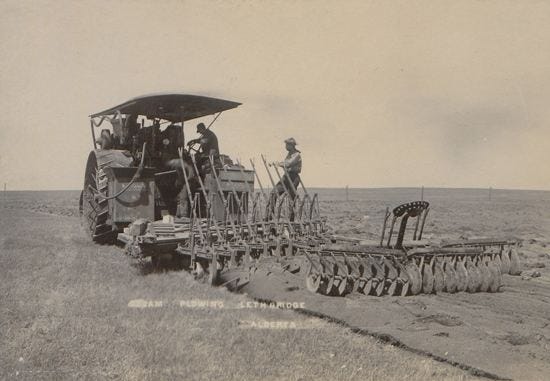
Image credit: Farm Collector Constant Torque: Steam engines produce maximum torque at zero RPM. This made them exceptionally good at starting heavy loads or pulling plows through thick, clay-heavy soil without “stalling” in the traditional sense.
Steam engines were not just for pulling; they were designed as mobile power plants. By using a flywheel and a long drive belt, the engine could transfer power to stationary machinery.
Threshing: The “Threshing Bee” became a staple of rural life. A steam engine would be parked, and a long belt would connect its flywheel to a grain separator (threshing machine).
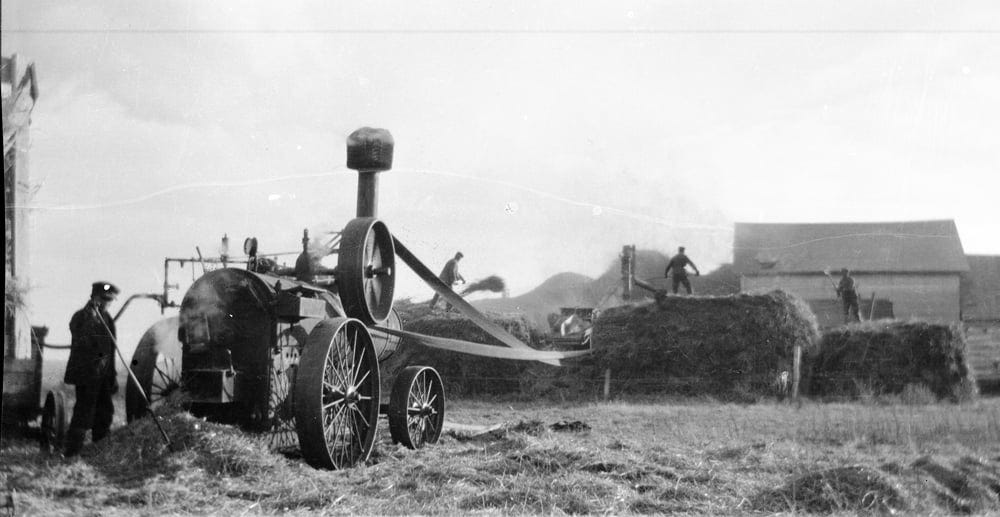
Efficiency: Steam provided a steady, consistent RPM that was far more efficient for threshing grain than the uneven pace of horse-powered “sweeps.”
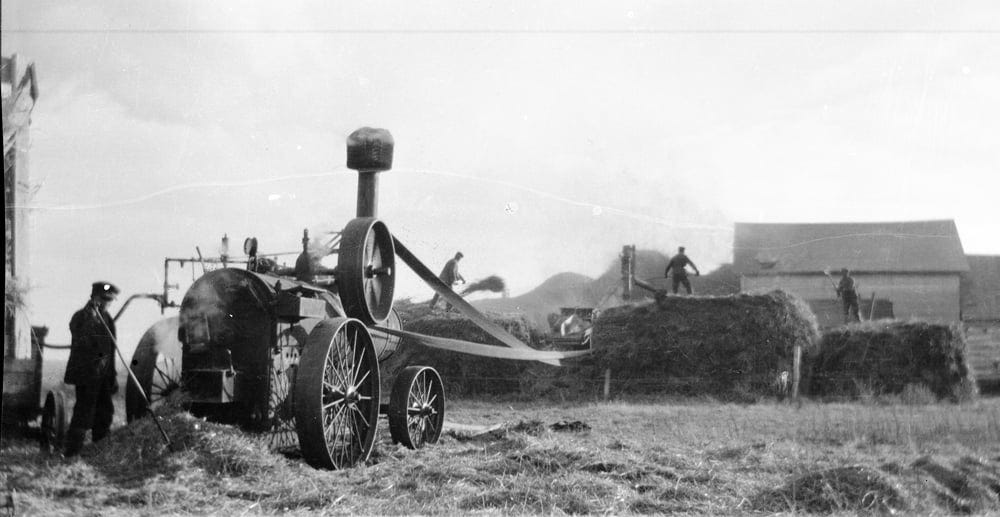
Unlike modern engines that require refined petroleum, steam boilers were “omnivorous.” Farmers could often fuel their operations using whatever was cheapest or most available on the land:
Coal and Wood: Common in most regions.
Straw: Many engines used in the prairies were “straw-burners,” allowing farmers to recycle the byproduct of the threshing process to power the engine itself.
Water: While engines required a massive amount of water, most farms were situated near sloughs, wells, or rivers, making the “fuel” essentially free.
While steam engines were complex to operate (requiring a skilled engineer and fireman), they were mechanically robust.
Low RPM: Because they operated at low speeds, the components didn’t wear out as quickly as high-speed gasoline engines.
Longevity: Many of these machines were built with heavy cast iron and thick steel, designed to last for decades under harsh conditions.
While a steam rig required a crew (an engineer, a fireman, and a water-wagon driver), it significantly reduced the total human labor required per acre.
Scale: It eliminated the need for dozens of teamsters to manage hundreds of horses.
Speed: Operations that took weeks with horses could be completed in days, which was critical for beating the unpredictable weather during harvest or seeding seasons.
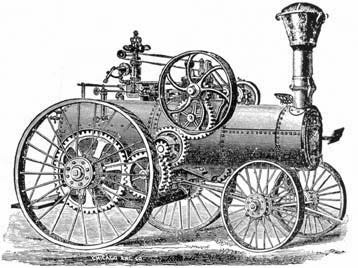
First Case steam traction engine.
Steam engines transformed farming in the 19th century, but their own characteristics made it easier for other power sources—especially internal combustion engines—to replace them.


Steam engines were bulky and extremely heavy, making them difficult to move between fields or farms.
Farming increasingly required mobile power (for plowing, harvesting, and transport).
Gasoline and diesel engines were smaller and lighter, allowing tractors to work directly in the fields.
This mobility advantage made newer engines far more practical for everyday farm work.
Steam engines required significant time to heat water and build pressure before they could operate.
Farmers often had to wait hours before the engine was ready.
Internal combustion engines could be started almost instantly, saving time and labor.
Faster startup meant farmers could respond quickly to changing weather and work schedules.
Operating a steam engine required skilled labor:
Constant fueling (coal or wood)
Monitoring water levels and boiler pressure
Regular cleaning and maintenance
In contrast, gasoline and diesel engines needed:
Fewer workers
Less specialized training
Reduced labor costs made newer power sources more economical.
Steam engines operated under high pressure, and boiler failures could cause dangerous explosions.
Accidents were costly and sometimes fatal. In the 40-year period between 1870 and 1910 there were at least 10,000 explosions in North America. Some 10,000 people were killed and another 15,000 injured.
Internal combustion engines posed lower catastrophic risk.
Improved safety encouraged farmers to adopt newer technologies.
Steam engines required a constant supply of clean water as well as bulky solid fuel.
This limited where and how long they could operate.
Liquid fuels (gasoline and diesel) were easier to store and transport.
Fuel flexibility favored newer engines, especially in remote areas.
Steam engines were less efficient at converting fuel into work.
Much energy was lost as heat.
Maintenance costs were high due to moving parts and boiler upkeep.
Internal combustion engines offered:
Better fuel efficiency
Lower long-term operating costs
Greater efficiency helped reduce overall farm expenses.
Steam engines were often used as stationary power sources (e.g., for threshing).
Farming evolved toward multi-purpose machines.
Tractors with internal combustion engines could plow, plant, harvest, and transport.
Versatility made newer engines far more valuable on modern farms.
As farming demanded faster, safer, cheaper, and more mobile power, internal combustion engines became the clear choice.
The shift in power sources led to:
Higher output per worker
Faster and more reliable farm operations
Larger farms with greater total production
In short, mechanized power turned farming from labor-intensive work into a highly productive industrial system, helping support growing populations and modern economies.
The change from steam power to internal combustion engines reshaped rural life and drove major migration patterns, especially from the late 1800s through the early 1900s.
The power shift in farming:
Reduced rural populations
Accelerated urbanization
Changed family structures and community life
Contributed to modern industrial society
In short, mechanization made farming more productive but emptied much of the countryside, pushing millions toward cities and permanently changing how societies were organized.
Steam boilers first came into industrial and agricultural use in what is now Alberta in the late 1800s, with widespread use by the 1870s–1890s, particularly for threshing, milling, mining, and transportation-related activities.
From 1900 to about 1915, steam boilers reached their peak use in Alberta.
Large steam traction engines used boilers to:
Pull multi‑bottom plows
Power threshing machines via belts
One steam outfit often served farms across a 10‑mile radius
Boilers burned coal, wood, or straw, depending on location
Steam boilers powered:
Sawmills
Coal mines
Grain elevators
Early oilfield equipment
While steam boilers dominated early on, they began to decline after 1905–1915, for the reasons discussed above.
While the arrival of smaller, more nimble gas tractors eventually ended the reign of steam, these “iron giants” were the catalyst that allowed farming to scale into the industrial operation it is today.
The oldest surviving physical steam boiler in Alberta is the original boiler on the c. 1885 Westinghouse 10‑hp portable steam engine, preserved at the Reynolds‑Alberta Museum (object no. R.1985.001.0540).
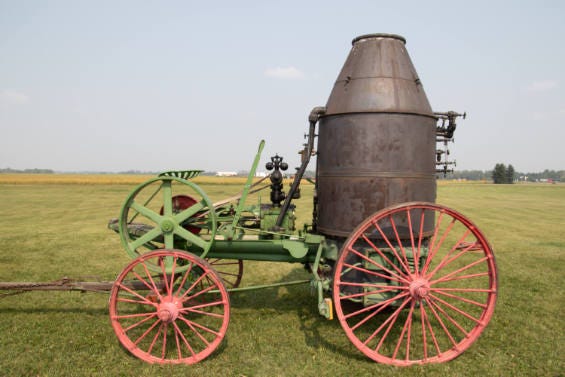
It was originally used by Albert B. Babb in Cheney, Washington, for sawmill and threshing service. Engines of this type and manufacture were used extensively in the US, South America, and Australia. The engine – and the water tube boiler in particular – bears the marks of the inventive genius of George Westinghouse and the fine craftsmanship of his builders; testimonials reveal that engines like this one were well-engineered, well-built, dependable and economical. Stan Reynolds acquired this steam engine from its owner in Washington in 1961. This steam engine was added to the Reynolds-Alberta Museum Collection in 1985.
Sources:
Heritage | ABSA the pressure equipment safety authority
https://grainswest.com/2020/09/goodbye-stallions-and-steam-hello-gasoline/
Alberta’s Steam Engine Heritage | Smokstak® Antique Engine Community*
